Welding of special-shaped parts: cracking the problem of difficult positioning and poor weld seam consistency.
Products such as special-shaped brackets for car chassis and complex components for agricultural machinery, due to their irregular weld seam orientation and changing spatial angles, have become a challenge in welding automation.
When welding manually, the welder needs to adjust the angle of the welding gun by experience, and the size deviation of the welds of the same batch of products can reach ±1mm, and the rework rate often exceeds 20%. When a car parts factory produces suspension brackets, four skilled welders are needed to work shifts because the welds include three 90° corners and two arc transitions. The daily output is only 800 pieces, and the assembly problems caused by the angle deviation account for 35% of the after-sales complaints.
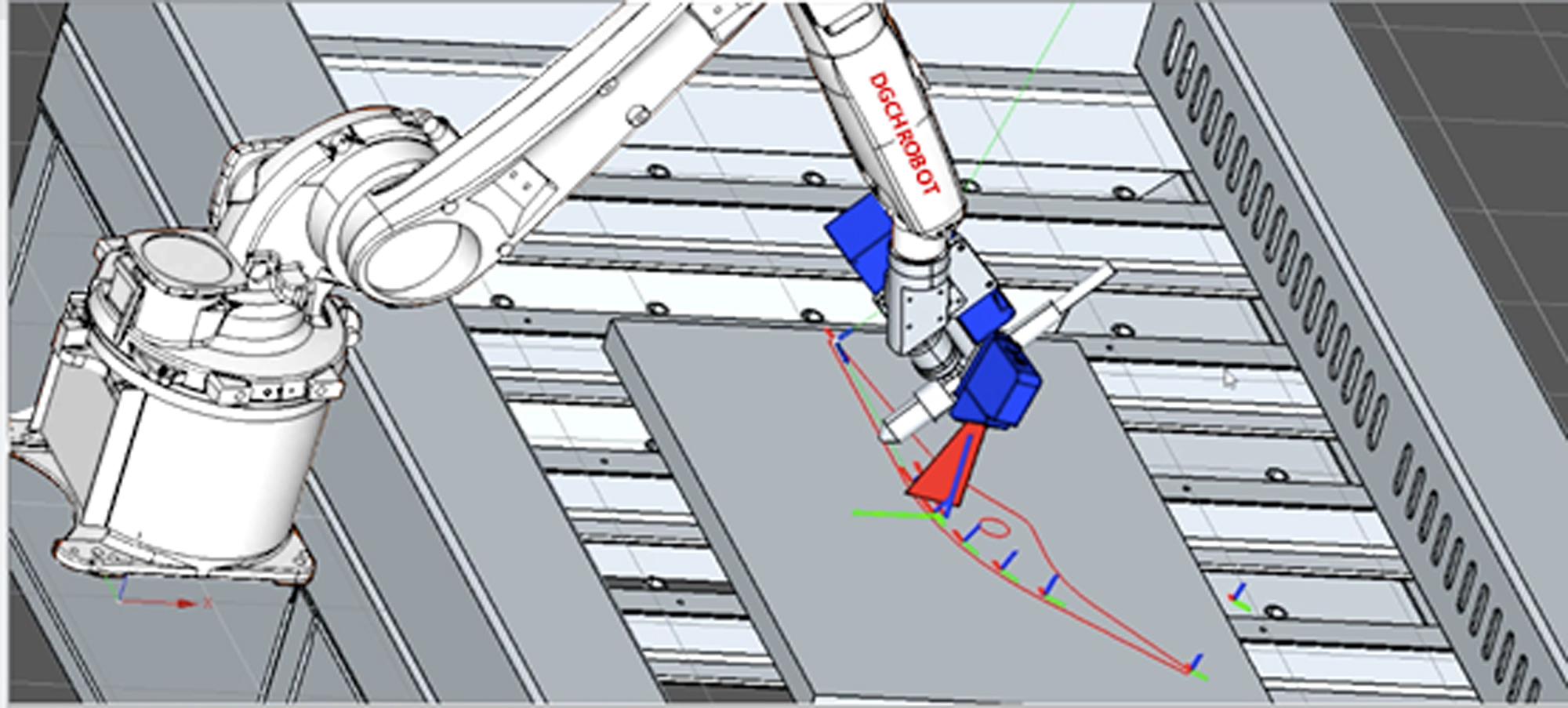
The 6-axis welding robot + 3D vision positioning system of Chaohong fundamentally solves this problem. The core of the system is "3D reconstruction + path self-adaptation": the 3D vision camera first scans the workpiece, generates a three-dimensional point cloud model, and compares it with the preset CAD model, automatically generating a welding path containing more than 1000 control points; the flexible wrist carried by the robot has a deviation compensation capability of ±5°, and even if there is a ±0.5mm positioning error in the workpiece, it can maintain the stability of the welding gun posture through real-time adjustment.
To adapt to small-batch and multi-variety production, the system has developed a "one-key call" function: the operator selects the workpiece model, the system automatically calls the corresponding welding program, and in combination with the quick-change fixture, the production time is shortened from the traditional 2 hours to 5 minutes. After the application of this system by a certain agricultural machinery enterprise, the weld size tolerance of the special-shaped frame is controlled within ±0.3mm, the rework rate is reduced to less than 3%, and the daily production capacity is increased to 2500 pieces, which is equivalent to replacing 6 skilled welders. It is worth mentioning that the system's offline programming function allows engineers to complete program writing in the office, and only verification is required on site, avoiding the occupation of traditional teaching on production, which is especially suitable for multi-variety small batch fields such as automotive parts and aerospace.