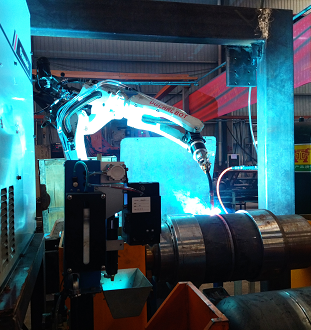
Pipe welding: solving the problems of uneven circumferential welds and efficiency bottlenecks
In pipeline construction in the oil and gas, petrochemical and other industries, long-distance pipeline welding has always been a problem that plagues enterprises. When welding manually, the welder needs to repeatedly flip the pipeline to adjust its position, which not only has a high labor intensity but is also prone to uneven force distribution, resulting in a significant difference in the weld bead, especially in the welding of thick-walled pipelines, where uneven heat input may cause local incomplete penetration, burying the risk of leakage. A certain petrochemical pipeline enterprise once reported that it takes more than 2 hours to weld a 6-meter-long DN500 pipeline manually, and it takes 3 workers 4 hours to grind after welding, with a qualification rate of only 75%, and the rework cost accounts for 15% of the total cost.
For this, Dongguan Chao Hong has launched the welding robot + lateral turning coordinate system: the robot is equipped with a high-precision weld tracking sensor, which can capture the position of the pipe ring seam in real time; the lateral turning coordinate machine then drives the pipe to rotate uniformly, ensuring that the welding gun is always perpendicular to the welding surface, keeping the heat input stable.
In the system, the variable position machine has a repeated positioning accuracy of ±0.1mm, and the trajectory repeated accuracy of the robot is 0.03mm, which can improve the flatness of the weld by 80%, complete single-sided welding and double-sided forming according to the process requirements, and the welding efficiency of a single 6-meter pipeline is 3 times higher than that of manual welding.
This not only reduces the grinding process after welding, but also increases the pass rate from 75% to 99%, which is especially suitable for the mass production of oil and chemical pipelines.
In practical application, a natural gas pipeline project adopted this system, and the welding time of a single 6-meter pipeline was shortened to 40 minutes, the flatness of the weld bead was improved by 80%, and the grinding process was reduced by 60%. More importantly, through the collaborative heating of the rotary table and the robot, the uniformity of the melting depth of the thick-walled pipeline was significantly improved, and the one-time qualified rate of the UT flaw detection increased from 75% to 99%. Calculating the annual production of 1000 kilometers of pipelines, it can save 3 million yuan in labor costs and reduce rework losses of more than 5 million yuan, which is particularly suitable for the batch welding scenarios of large-diameter and thick-walled pipelines.