Aluminum welding dedicated welding robot: An automated tool to overcome aluminum welding problems
In modern industrial manufacturing, aluminum and aluminum alloys are widely used in high-end fields such as new energy vehicles, aerospace, and rail transit due to their excellent properties such as light weight, high strength, and corrosion resistance. However, the problems of oxide film barrier during aluminum welding, uneven heat input caused by high thermal conductivity, and deformation caused by large linear expansion coefficient have always been the bottlenecks that restrict welding quality and efficiency. The aluminum welding dedicated welding robot is an automated equipment tailor-made for these pain points, which has achieved precise control and efficient execution of aluminum welding process through technological innovation, and has become a key force to promote the upgrading of aluminum processing industry.
1. Core characteristics of aluminum welding dedicated welding robots
The particularity of aluminum welding poses stringent demands on equipment that go far beyond ordinary metal welding, and dedicated robots, through targeted design, have built a technical system that is compatible with aluminum welding processes.
On the level of process adaptation, the robot deeply integrates the core technology of aluminum welding, forming a systematic solution to problems such as oxidation and thermal runaway. The aluminum surface easily forms an oxide film (Al₂O₃) with a melting point as high as 2050℃, far exceeding the 660℃ melting point of aluminum itself. If not properly handled, it will directly lead to defects such as incomplete fusion. The dedicated robot is equipped with a pulse MIG welding (Melting极气体保护焊) system, which uses the mechanical impact force generated by the high-frequency pulse current to "break" the oxide film, while cooperating with a high-precision argon gas protection device (flow control accuracy up to ±1L/min), forming a stable inert gas atmosphere in the welding area, reducing oxidation reactions from the source. In view of the characteristics that the aluminum's thermal conductivity is three times that of steel and heat is easy to spread, the closed-loop temperature control system built into the robot can regulate the current, voltage, and welding speed in real time, ensuring that the pool temperature is always in the ideal range, avoiding "cold welding" or "over welding".
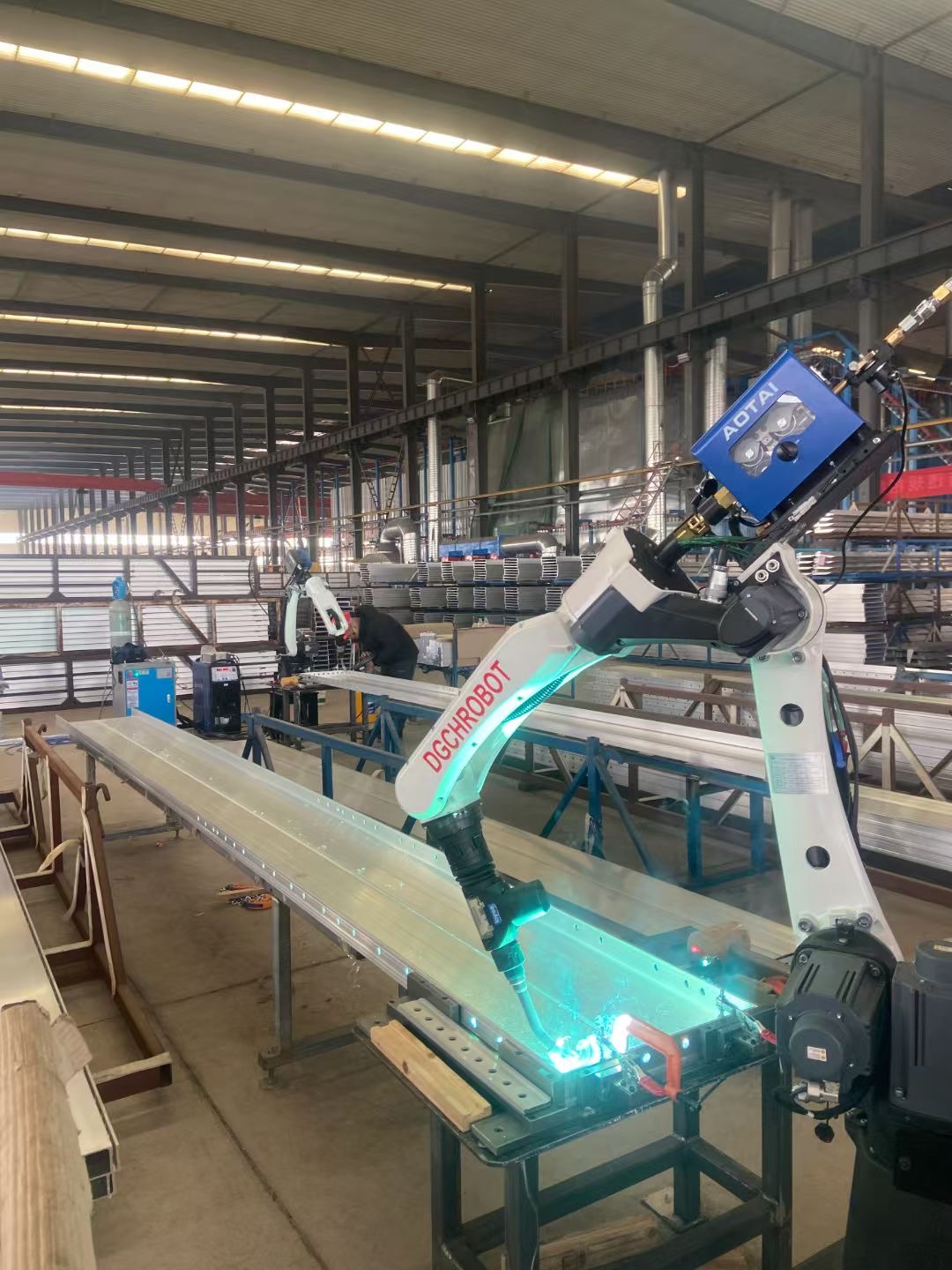
Another core to ensure the quality of aluminum welding is the consistency of the welding gun trajectory and the stability of the wire feeding. Aluminum welding has extremely high requirements for the consistency of the welding gun trajectory, especially in complex groove or thin-walled parts welding, where even a slight position deviation can lead to weld defects. The dedicated robot uses a high-precision servo drive system with a repeat positioning accuracy of ±0.02mm, and is equipped with a 6-axis or 7-axis high-degree-of-freedom robotic arm, which can accurately reproduce complex weld trajectories. The aluminum wire is soft in nature (with a tensile strength only 1/3 of steel), and it is prone to bending and wire breakage during wire feeding. The robot is equipped with a dual-drive wire feeding mechanism that controls the wire feeding speed fluctuation within 1% through synchronous driving of the front and rear wheels and self-adaptive pressure adjustment, ensuring a uniform and stable deposit.
The intelligent monitoring and self-adaptive regulation capability endow the robot with the closed-loop control capability of "sensing - decision-making - execution". The integrated arc sensor can sense the relative position deviation between the welding gun and the workpiece in real time through the voltage / current change, dynamically correct the trajectory to compensate for the workpiece clamping error; the infrared temperature measurement and vision system jointly monitor the pool shape, and automatically adjust the heat input parameters when the pool is too large (which may cause burn-through) or too small (which may not be fusion); the built-in defect recognition algorithm can perform real-time warning of typical defects such as porosity, cracks, etc., and record welding process data (parameters, images, timestamps) to provide a basis for quality traceability.
2. Significant advantages of aluminum welding dedicated welding robots
The technical features of dedicated robots are transformed into multiple advantages in actual application, reshaping the production mode of aluminum welding from the dimensions of quality, efficiency, and cost.
The stability and reliability of welding quality have achieved a leap in quality. When welding aluminum manually, the consistency of welds is extremely poor due to factors such as the skill level of welders, fluctuations in physical strength, and emotional state, with defect rates often reaching 5%-10%, making it difficult to meet the quality requirements of high-end manufacturing. Specialized robots, through the execution and precise control of standardized parameters, have reduced defect rates to below 0.5%. Especially in the welding of automotive aluminum fuel tanks and pressure vessels with strict sealing requirements, 100% air-tightness testing of welds has been successfully achieved. In the welding of battery cases for new energy vehicles, the deviation of weld bead penetration does not exceed 0.1mm, meeting the requirements for preventing leakage and structural strength of the battery pack.
Significant improvements in production efficiency and cost optimization. Robots can achieve 24-hour continuous operation, with welding efficiency reaching 2-3 times that of manual labor. For example, in the welding of automotive aluminum wheels, manual labor can complete 8-10 pieces per hour, while robots can consistently achieve 20-25 pieces per hour. In terms of material utilization, precise control of the welding bead reduces wire waste by 10%-15%. Calculating the annual production of 100,000 aluminum parts, this can save more than a million yuan in wire costs. More importantly, the stability of quality significantly reduces the rate of rework (by more than 60%), indirectly reducing the secondary consumption of labor and materials.
The reduction of human reliance has resolved the dilemma of the shortage of skilled aluminum welding technicians. It takes 2-3 years of systematic training to cultivate a proficient aluminum welder, and the average monthly salary generally exceeds 10,000 yuan, with higher salaries for welders in the high-end field. Specialized robots can be trained to operate by a regular operator after 1-2 weeks of training, using a preset process parameter library (覆盖 different thicknesses and brands of aluminum welding schemes), which greatly reduces the human threshold. After a certain aerospace parts manufacturer introduced robots, the demand for welders was reduced from 12 to 3 people, saving more than 800,000 yuan in annual labor costs.
Adaptability to complex working conditions and the expansion of automated integration capabilities have pushed the boundaries of application. For the complex structure of spatial welds on irregular beveled aluminum profiles for new energy vehicle motor casings, robots, with their flexible wrist design and offline programming function, can precisely complete welding in narrow spaces (*** minimum working radius 50mm) and at multiple angles (±180°). At the same time, robots can be seamlessly connected with feeding and discharging robotic arms, laser detection equipment, and MES systems, to construct a fully automated production line from workpiece feeding to finished product inspection, achieving real-time upload and traceability of production data.
The improvement of safety and environmental performance reflects the humanistic care of modern industry. The arc light and aluminum smoke (long-term contact may cause pneumoconiosis) generated during the aluminum welding process pose a significant health hazard to operators. The dedicated robot can work in a closed workstation, combined with an efficient smoke purification system (purification efficiency of 99.9%), to control the dust concentration in the working environment below 0.5mg/m³.