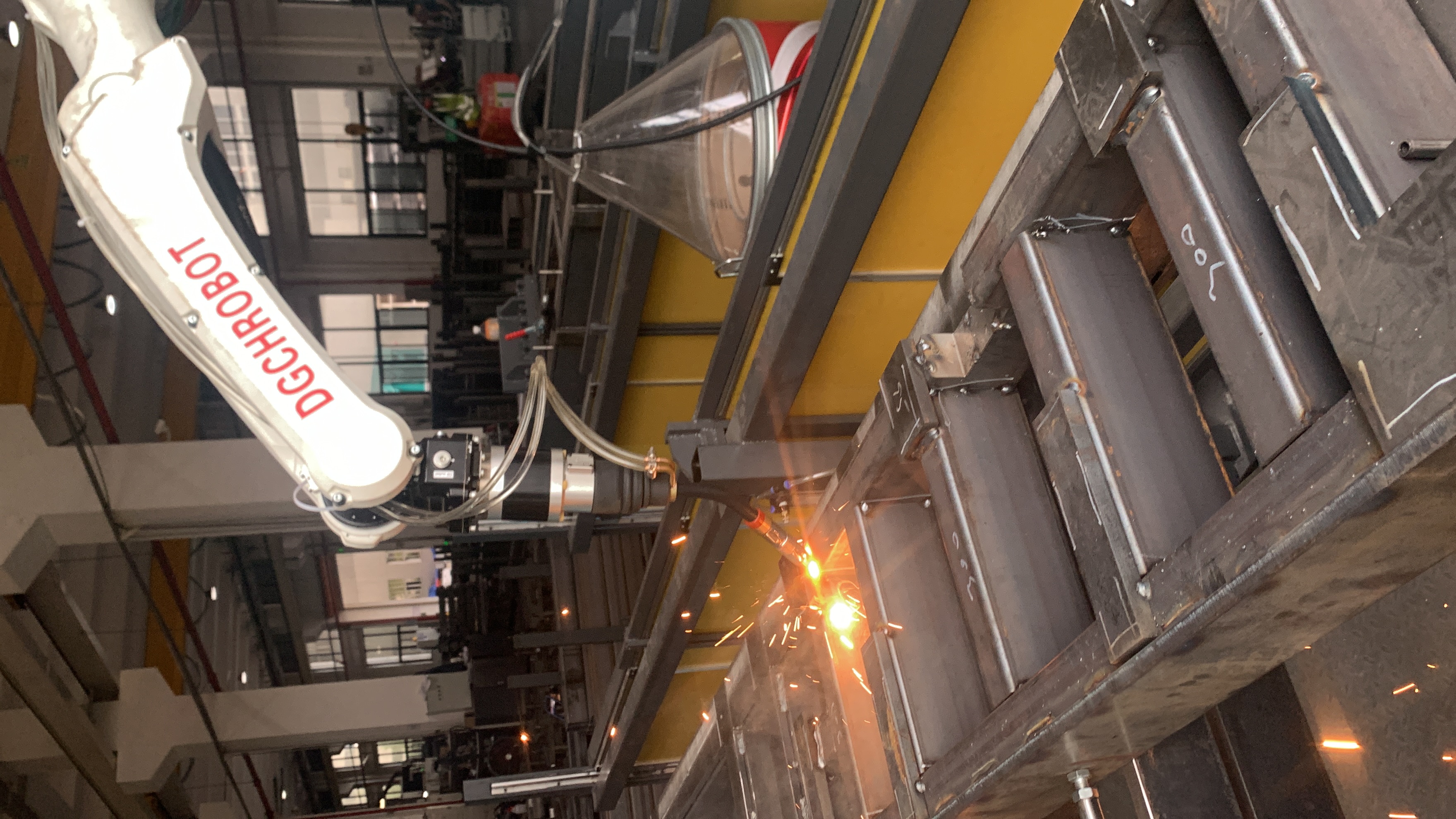
In the food and beverage machinery sector, the welding of equipment like stainless steel storage tanks and metal frames must strictly adhere to hygienic-grade standards (e.g., 3A, EHEDG, FDA). Core requirements include smooth, crevice-free welds, no oxidation discoloration, no residual welding spatter, while also accommodating the thermal sensitivity of stainless steels (especially 304/316L austenitic stainless steel) to avoid issues like intergranular corrosion and thermal distortion.
The design of welding robot solutions must revolve around three principles: low heat input, high cleanliness, and all-position adaptability. Common types can be categorized as follows:
I. Robot Solution Types Based on Welding Process
1. Pulsed Metal Inert Gas/Metal Active Gas Welding Robot – Mainstream Solution for Medium-Thickness Tank and Frame Welding
For butt joints of stainless steel tank shells (thickness 3-12mm) and fillet joints of frame beams and columns (thickness 2-8mm), robots often use pulsed MIG welding (shielding gas: 98% Ar + 2% CO₂ or pure Ar). This method controls droplet transfer (one pulse per drop) via pulsed current, achieving "low heat input" and "single-sided welding with back formation".
Advantages: High welding speed (30% faster than conventional MIG), narrow heat-affected zone (≤2mm), effectively preventing intergranular corrosion in stainless steel due to overheating. The weld bead is aesthetically pleasing, with reinforcement easily controlled at 0.5-1mm (meeting the hygienic standard for "smooth transition"). Robots can coordinate with gantry systems or floor tracks for continuous circumferential welding of tank shells, or use positioners to manipulate frame workpieces for all-position fillet welding.
Applicable Scenarios: Longitudinal/circumferential seam welding of large stainless steel tanks; rapid assembly of food factory framework structures.
2. Tungsten Inert Gas Welding Robot – High-Precision Solution for Thin-Walled Hygienic Components
For thin-walled stainless steel parts (e.g., tank manholes, nozzles, clamp connectors for sterile piping, thickness 0.8-3mm) in food and beverage machinery, robots are often paired with cold wire or hot wire TIG welding. Using pure Ar as shielding gas and a non-consumable tungsten electrode, they precisely control welding current (5-200A) to achieve "spatter-free" and "full penetration" welds.
Advantages: Extremely high weld purity (no slag, no impurities), surface roughness can reach below Ra 0.4μm, fully meeting requirements for "easy cleaning" and "no sanitary dead ends". Robots, combined with micro-torches and vision positioning systems, can accurately weld small-diameter nozzles (≤50mm) or complex curved manhole flanges, avoiding uneven welds caused by hand tremors in manual TIG.
Special Optimization: For molybdenum-containing stainless steels like 316L, robots can adjust current waveforms (e.g., using square wave TIG) to reduce molybdenum loss and ensure weld corrosion resistance.
3. Laser Welding Robot – High-Efficiency Precision Solution for High-End Aseptic Equipment
For equipment requiring high cleanliness (e.g., inner liners of aseptic filling machines, stainless steel reactors for biopharma, thin-walled shells of high-end beer fermentation tanks), robots often use fiber laser welding (wavelength 1070nm). A focused laser beam (spot diameter 0.1-0.5mm) enables "keyhole welding" and high-speed welding.
Advantages: Heat input is only 1/10th of TIG, heat-affected zone ≤0.5mm, resulting in minimal distortion. The weld is narrow (0.2-0.8mm) with nearly zero reinforcement (fine "fish-scale" pattern), potentially meeting hygienic standards without post-weld polishing. Robots equipped with scanner systems enable "remote welding," reducing contamination risk by keeping the torch away from the workpiece, ideal for cleanrooms (Class 100/1000).
Limitations & Applicability: Higher equipment investment; mainly for thin-walled stainless steel (≤6mm) or high-end products requiring a "seamless appearance" (e.g., imported dairy processing equipment).
II. Robot Workstation Types Based on Equipment Configuration
1. Tank Circumferential Seam Welding Workstation – Dedicated Solution for Large Vertical/Horizontal Tanks
This system consists of a welding robot, a two-station positioner, and a gantry travel system. The positioner carries the tank shell section, precisely rotating it (speed 0.1-1 rpm) via servo motor to keep the circumferential seam in the "flat welding position." The robot, mounted on the gantry, moves along the tank's axis (speed 50-500 mm/min), working with a pulsed MIG torch to complete continuous circumferential welding.
2. Frame Fillet Welding and Assembly Workstation – Efficient Solution for Factory Metal Frames
For welding frames like production line racks, shelves, and operation platforms in food plants, a six-axis robot and a two-station positioner are used. The robot is floor-mounted, while the positioner handles the frame workpiece. By rotating the positioner, all-position welding (e.g., "horizontal fillet welding") for beams and columns is achieved. Operators can load/unload workpieces simultaneously with welding, enabling a continuous cycle (cycle time ≤5 min).