In the field of industrial production, welding technology, as an important means of connecting metal parts, is widely used and crucial. The quality of the weld seam directly affects the strength, stability, and service life of the entire welded structure.
Therefore, today Xiao Chao will explore the impact of different welding methods on weld quality with you, to help improve welding technology and enhance the benefits of product quality.
01 The influence of welding current, arc voltage, welding speed on the weld
Welding current
When the welding current increases (other conditions unchanged), the penetration and height of the weld increase, while the width of the fusion remains unchanged (or slightly increases) for the following reasons:
① After the current increases, the arc force and heat input on the workpiece both increase, the position of the heat source moves down, and the penetration increases. The penetration is nearly proportional to the current.
② After the current increases, the amount of wire melting increases nearly proportionally, and since the width of the fusion remains nearly unchanged, the height of the weld increases.
③ After the current increases, the diameter of the arc column increases, but the depth of the arc into the workpiece increases, and the range of motion of the arc spot is limited, so the width of the fusion remains nearly unchanged.
Arc voltage
After the arc voltage is increased, the arc power is increased, the heat input into the workpiece is increased, and at the same time, the arc length is stretched, the distribution radius is increased, so the melting depth is slightly reduced and the melting width is increased; the weld reinforcement is reduced, because the melting width is large, and the melting amount of the welding wire is slightly reduced.
Welding speed
When the welding speed increases, the line energy decreases, and the penetration and width of the weld, as well as the height of the weld, all decrease. This is because the amount of filler metal deposited per unit length of the weld is inversely proportional to the welding speed, and the width of the weld is approximately inversely proportional to the square root of the welding speed.
02 Defects in weld bead formation and the causes of defect formation
Underwelding: The phenomenon of incomplete penetration at the root of the joint in welding is called underwelding. The causes of its formation are small welding current, high welding speed, improper size of the groove, and the welding wire not being aimed at the center of the weld, etc. When using short-circuit transition with fine welding wire in CO2 welding, it is easy to produce this defect due to the low heat input of the workpiece.
Pierce: When welding, the molten metal flows out from the back of the weld seam, forming a hole, which is called pierce. Excessive welding current, too small welding speed or too large gap groove size may cause this defect.
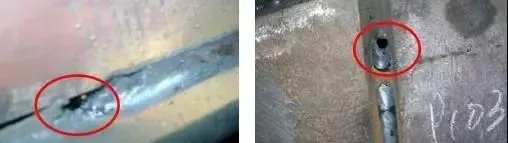
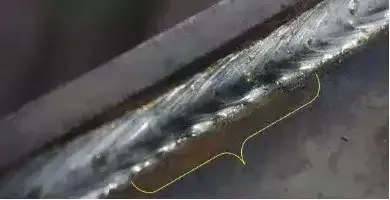
Undercut: The phenomenon of melting and forming a groove or depression on the parent metal part along the weld is called undercut. Defects may occur during welding with high current and high speed. When welding the fillet weld with the web in the vertical position, if the weld leg is too large or the voltage is too high during a single welding, undercut will also occur, and improper operation during welding the butt joint will also cause it.
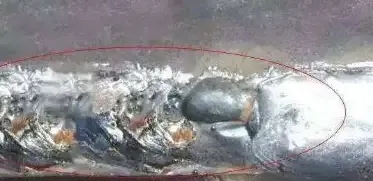
Welding瘤: 在熔焊时,熔化的金属流到焊缝以外未熔合的母材上形成金属瘤的现象叫焊接瘤。焊接瘤是由填充金属过多引起的,这与间隙和坡口尺寸小、焊速低、电压小或焊丝伸出长度大等有关。
03 Different welding methods will produce different weld shapes
Manual arc welding: typically results in narrow and deep welds with a slightly convex surface and a certain degree of ripple. However, due to manual operation, there is poor consistency in the welds, and slag needs to be removed. Automation of arc welding: Arc welding uses the heat from the arc to melt the workpiece for connection. Depending on the medium of the arc, arc welding can be divided into various types, such as argon arc welding, carbon arc welding, etc. This method is simple to operate, low-cost, and has a wide range of applications. However, if operated improperly or with unreasonable parameter settings, it may result in uneven welds, porosity, or slag inclusion defects.
Soldering:
The weld is wider and flatter, with a smooth weld surface and a more rounded weld bead. Suitable for both thin and thick plates, with a greater depth of fusion, but the heat-affected zone is larger with gas welding, and if the welding speed is too slow, it can lead to insufficient strength and toughness of the weld.
Laser welding:
The weld is narrow and deep, with a smooth and fine weld surface. This method has the advantages of small heat-affected zone, fine weld, and fast welding speed, which is especially suitable for high-precision welding. The clearance and alignment accuracy are strictly required, and it is sensitive to cracks.
Resistance welding:
Spot welding forms individual weld spots, while seam welding forms continuous weld seams or a series of overlapping weld spots. Suitable for welding thin sheet metals, but the strength of the weld spots or seams is limited, not suitable for structural parts that bear high loads.
Pulse welding:
The weld is in the shape of a runway, solid-phase welding, no heat-affected zone, especially suitable for dissimilar materials such as aluminum-copper, aluminum-steel, etc. The welding conditions are low, no pre-welding and post-welding heat treatment is required. High energy loading, millisecond welding, high production efficiency.